← Back to experience

KTH Royal Institute of Technology · Pyrolysis research · Reactor concepts & techno-economics

Student Intern (Pyrolysis) — KTH Royal Institute of Technology

Contributed to early-stage KTH research on plastic pyrolysis: reviewing reactor configurations, analysing cost drivers for oil extraction from polymer waste, and supporting technical and economic feasibility evaluation for thermochemical decomposition pathways.

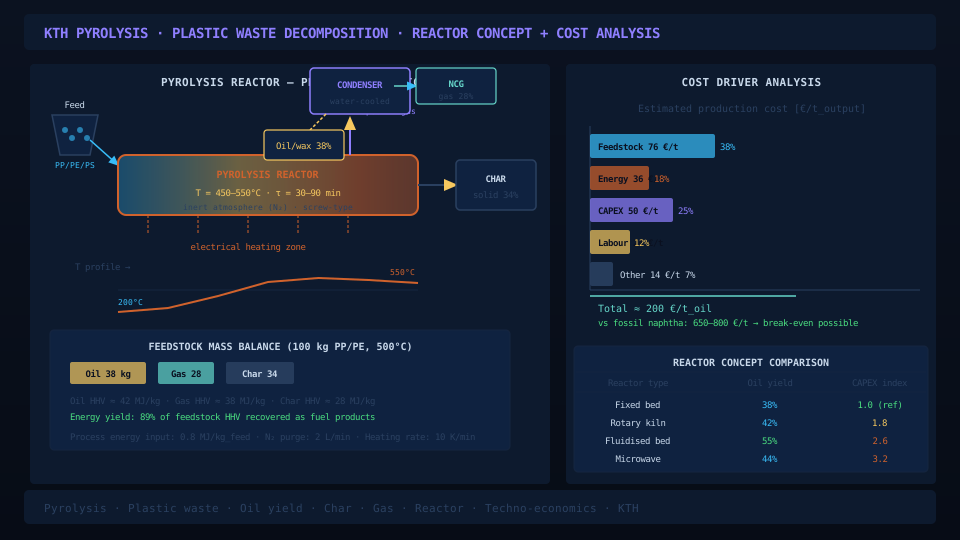
KTH pyrolysis reactor plastic decomposition visual

What I contributed

  • Reviewed reactor configurations for plastic pyrolysis including fixed-bed, fluidized-bed, rotary kiln and microwave-assisted reactors, assessing their suitability for mixed polymer feedstocks.
  • Analysed product yield distributions (oil, gas, char) and the operating-condition dependencies (temperature, residence time, heating rate) that govern conversion efficiency.
  • Examined cost drivers for oil extraction from polymer waste streams, identifying feedstock pre-treatment, energy input and product separation as the dominant contributors.
  • Supported early-stage techno-economic feasibility framing, translating reactor and process data into cost-per-unit and energy-intensity estimates for research decision support.
  • Engaged with the intersection of thermochemical decomposition, reactive flows and heat transfer — areas that subsequently deepened the research interest developed through the Siemens thesis.

Research connection

Why this role matters for the research track

This internship sits at the intersection of high-temperature thermochemistry, reactive flows and engineering feasibility — themes that directly overlap with the thermal-fluid interests I developed more rigorously through the Siemens Energy thesis (TRITA-ITM-EX 2026:14). Plastic pyrolysis involves coupled heat transfer, fluid mechanics and chemical kinetics in a high-temperature reactive environment, which requires a working understanding of thermal decomposition pathways, phase-change energetics and residence-time effects.

The experience of translating reactor physics into cost-analysis and feasibility framing also strengthened my ability to work across the boundary between scientific description and engineering decision-making — a skill directly applicable to doctoral research contexts where simulation outputs need to connect to observable physical behaviour and measurable performance metrics.

Research interests that emerged or were reinforced from this role: catalytic and thermal pyrolysis of polymers, deposit formation from thermal decomposition products, and surface-condition effects on heat transfer in high-temperature passages.