Academic record
Courses
Formal coursework across two degrees — M.Sc. Sustainable Energy Engineering at KTH Royal Institute of Technology (2023–2026) and B.Tech Mechanical Engineering at APJ Abdul Kalam Technological University (2017–2021). Each course is linked to related portfolio work where applicable.
M.Sc. Sustainable Energy Engineering — KTH Royal Institute of Technology
Stockholm, Sweden · 2023–2026 · School of Industrial Engineering and Management (ITM) · Focus: heat and power technology, energy systems modelling, optimisation and CFD
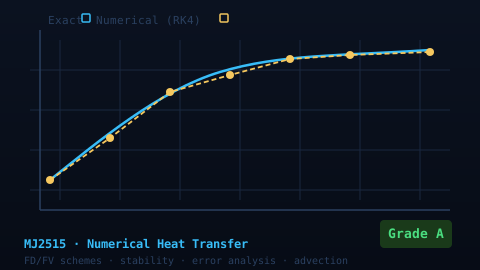 MJ2515 / Grade A
Numerical Heat Transfer
Finite difference, RK4, advection schemes and error analysis.
MJ2515 / Grade A
Numerical Heat Transfer
Finite difference, RK4, advection schemes and error analysis.
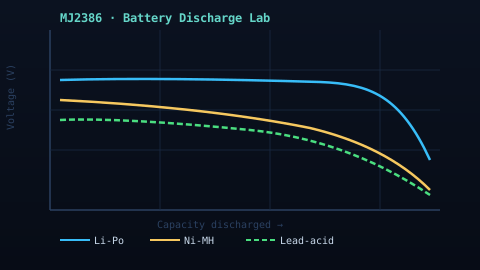 MJ2386 / Grade B
Battery Discharge Lab
Discharge curves and chemistry comparison for Ni-MH, Li-Po and lead-acid cells.
MJ2386 / Grade B
Battery Discharge Lab
Discharge curves and chemistry comparison for Ni-MH, Li-Po and lead-acid cells.
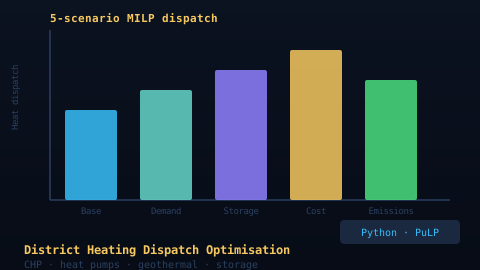 Optimisation
District Heating Dispatch
LP/MILP scenarios for heat supply, storage, cost and emissions.
Optimisation
District Heating Dispatch
LP/MILP scenarios for heat supply, storage, cost and emissions.
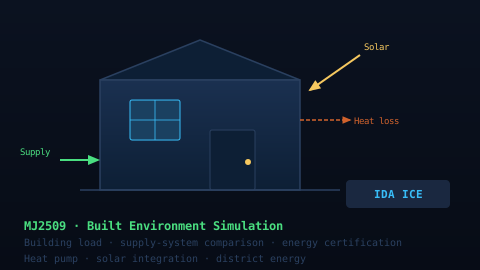 IDA ICE
Built Environment Simulation
Building load and supply-system comparison evidence.
IDA ICE
Built Environment Simulation
Building load and supply-system comparison evidence.
Thesis
Degree Project in Heat and Power Technology
Independent thesis requiring the student to solve an engineering problem with significant technical content. This thesis (TRITA-ITM-EX 2026:14) was conducted at Siemens Energy Finspång: compressible CFD and conjugate heat transfer analysis of a reducer for the Pulsatorn high-temperature dynamic pressure sensor calibration rig, comparing legacy two-step geometry against a 150 mm quintic C² redesign. Includes mesh independence, Biot number analysis, NI-DAQ commissioning and a formal root cause analysis of heater failure.
Numerical methods & heat transfer
Numerical Heat Transfer in Energy Technology
Finite difference and finite volume methods for heat conduction, convection and advection problems in energy applications. Covers derivation of numerical schemes, stability and error analysis, 1D and 2D steady-state and transient solutions, and an introduction to the Navier–Stokes equations and turbulence modelling. Practical work includes programming numerical solvers and interpreting CFD software output.
AI, optimisation & data
Applied AI for Sustainable Energy Engineering
Machine learning theory and applications for energy engineering: technique selection, data pre-processing, model training, hyperparameter search, model evaluation and comparison against conventional approaches. Topics include logistic regression, shallow and deep neural networks, feature engineering and ethical dimensions of AI in the energy sector. Course projects included day-ahead building heating demand forecasting and district heating dispatch optimisation.
Practical Optimization of Energy Networks
Industry-partnered course (FORTUM, Vattenfall) applying optimisation tools to real-world heat and power networks. Covers LP and MILP formulation for thermal network dispatch, combined heat and power scheduling, and market-driven operation of district energy systems. Project-based format with oral presentation and written report.
Thermal power & renewable energy
Sustainable Power Generation
Thermodynamic cycles, conventional and renewable power plant configurations, environmental impacts and sustainability assessment. Covers steam and gas turbine cycles, combined-cycle plants, integration of wind and solar into power systems, and electrical engineering aspects of grid connection. Foundational course for the MSc Sustainable Energy Engineering programme.
Renewable Energy Technology
Technical evaluation of solar photovoltaic and thermal, biomass and biofuels, wind power, hydropower, and electrical and thermal energy storage. Emphasis on energy balance calculations, fluid mechanics and thermodynamics fundamentals applied to renewable conversion systems. Builds the resource and technology knowledge base for design and scenario work.
Applied Heat and Power Technology
Practical assessment of thermal power systems: steam turbines, gas turbines, gas motors, waste heat recovery, biomass and waste-to-energy, concentrated solar power, wind integration and combined heat and power. Includes design of customised energy systems and techno-economic and environmental feasibility assessment for realistic applications. Prerequisite: MJ2405 and MJ2411.
Energy systems modelling & scenarios
Modeling of Energy Systems — Heat and Power Generation
Project course using modelling software (HOMER Pro, EnergyPRO or equivalent) for heat and power system design and analysis. Lectures introduce modelling strategies and tools, followed by group project work with industry clients. Students formulate, calibrate and validate system models, perform sensitivity analysis and present findings in a report and oral presentation. Covers solar thermal, heat pump, PV and district heating configurations.
Energy Systems for Sustainable Development
3E (Energy–Economy–Environment) scenario analysis of national and regional energy systems using LEAP (Low Emissions Analysis Platform). Covers energy mix transitions, climate policy, technology alternatives, SDG 7 access and energy poverty, geopolitical energy dependencies and integrated resource planning. Includes comparison of industrialised and developing-country energy contexts.
Small Scale Polygeneration
Simultaneous generation of electricity, heat, cooling, purified water and dry air from renewable and conventional sources. Covers energy converter selection, thermo-economic optimisation, control strategies, environmental and economic performance, and grid-connected versus islanded operation. Case studies include remote-area systems and off-grid emergency applications.
Energy storage & built environment
Energy Storage Technology
Classification and design of mechanical, thermal and electrochemical storage systems. Covers working principles of batteries (Ni-MH, Li-ion, lead-acid), thermal energy storage (sensible, latent/PCM), hydrogen and compressed air, with emphasis on integration into renewable energy systems and techno-economic KPI evaluation. Labs include discharge characterisation and M-TES PCM thermal testing.
Energy in the Built Environment
Building energy demand, heating and cooling systems, ventilation, district energy and supply-side infrastructure. Covers thermal comfort requirements, building simulation using IDA ICE, heat pump and solar integration, energy certification and renovation assessment. Project work involves modelling a real or representative building through supply-side design alternatives.
Energy management & research methods
Energy Management
Systems analysis of city and district energy systems, combining high-level strategic planning with bottom-up techno-economic analysis. Covers ISO 50001-aligned energy performance indicators, scenario and sensitivity analysis, renewable integration planning, cost-effectiveness evaluation and business model development. Major project simulates a real city-scale energy management challenge with multiple stakeholder constraints.
Methods of Research in Sustainable Energy
Thesis preparation course covering systematic literature reviews, research problem formulation, methodology selection, uncertainty analysis and scientific ethics. Combines seminars, assignments and written examination. Students formulate a research question and methodology proposal relevant to their thesis topic, evaluated against sustainable development and ethical dimensions.
Exchange & elective
Circular Economy for Energy Storage
Virtual exchange course through the Unite! European university alliance (Aalto University, Oct–Dec 2024). Applies circular economy frameworks to battery and energy storage technology: lifecycle assessment, second-life battery pathways, recycling supply chains, critical raw material sourcing (lithium, cobalt, nickel), EU Battery Regulation compliance and end-of-life collection schemes. Credited as 3 ECTS towards the KTH programme. Complements battery discharge characterisation and PCM thermal storage work from MJ2386.
Entrepreneurship for Engineers
Introduction to entrepreneurial thinking, business model design, market validation and venture creation for engineering students. Includes idea-to-concept work, pitch development and exposure to startup frameworks relevant to clean-technology ventures.