The problem
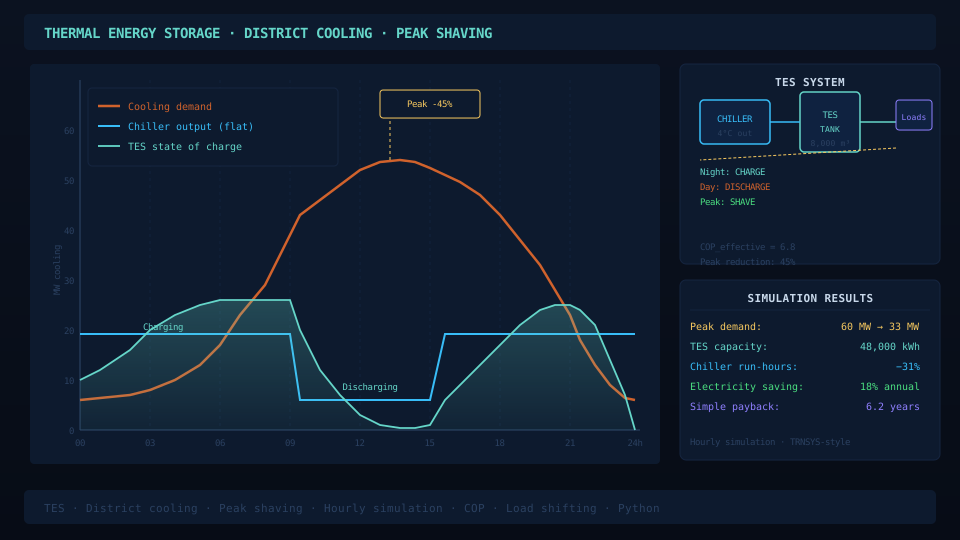
A shopping centre connected to a district cooling network experiences dramatic swings in cooling demand — from 198 kW during off-peak hours to 3,391 kW at peak, with daily maxima varying between 1,541 kW and 3,391 kW across an eight-day observation window. Operating a chiller plant sized for peak demand is expensive and inefficient; the excess capacity sits idle most of the time while peak-hour electricity consumption drives up costs.
The project aimed to design a thermal energy storage system that charges during cheap off-peak hours and discharges during expensive peak periods, comparing ice storage and salt hydrate PCM on cost, volume, energy density and lifetime economics.
Engineering contribution
- Built a Python simulation implementing a partial storage load-levelling strategy with a 1,850 kW demand threshold, 12-hour look-ahead window for predictive charging and dynamic SoC tracking.
- Applied UK electricity tariffs (day: 16.16 p/kWh from 07:00–23:00; night: 9.01 p/kWh from 23:00–07:00; standing charge 9.24 p/day) to calculate original and adjusted demand costs.
- Calculated ice storage and PCM sizing, cost and volume for a 14,750 kWh capacity requirement.
- Compared lifetime economics including break-even periods and total profit over technology lifespan.
Technology comparison: ice vs PCM (14,750 kWh)
Ice storage: 42 kWh/ton at 87.5% efficiency, $1,150/ton. PCM (salt hydrate): 60 kWh/ton at 90% efficiency, $7,000/ton. PCM is more energy-dense and efficient, but costs are 4.3× higher for the same capacity. At $2,220/week saved through peak shaving:
- Ice storage break-even: 3.5 years; lifetime profit over 17.5 years: ~$1.6M
- PCM break-even: 14.9 years; lifetime profit over 20 years: ~$589k
The economics strongly favour ice storage for this scenario. PCM’s advantages — higher energy density, smaller footprint (273 vs 320 m³), longer lifespan, 10,000+ charge-discharge cycles — are most relevant when space is a binding constraint. Shopping centres typically have large footprints and potential underground storage, so space is not the deciding factor here.
Simulation results
The TES simulation successfully maintained adjusted cooling demand below the 1,850 kW threshold during all peak periods by charging during the cheaper night-rate window and discharging during day-rate hours. The state-of-charge (SoC) stayed within operational limits throughout, confirming that the 14,750 kWh capacity was sufficient for the load profile without over-cycling or depletion.
PCM characteristics
The project reviewed PCM technology in depth as the higher-performance alternative. Key properties of salt hydrate PCMs relevant to cooling applications:
- Energy density ~100 kWh/m³ (vs ~25 kWh/m³ for sensible heat water storage)
- Temperature stability during charge/discharge — latent heat release at near-constant temperature
- Operational range -30°C to 120°C; activation temperature tailored to the cooling application
- Lifespan exceeds 10,000 charge-discharge cycles
- ROI typically 3–6 years at standard energy prices; in this case extended to 14.9 years due to the large capacity requirement and high unit cost
Decision and limitations
Ice storage was recommended for this scenario. The decision framework is transferable: where space is constrained, PCM’s 90% footprint reduction and higher energy density justify the cost premium. Where space is ample, ice storage’s cost advantage dominates.
The main modelling limitation is the use of fixed day/night average tariffs rather than dynamic spot pricing. In a real UK electricity market, half-hourly prices vary considerably, and a dynamic pricing model would shift more charging to ultra-low-price hours, improving the economic case for both technologies.