The problem
District heating is a strong fit for urban areas, but dispatch planning becomes difficult when demand varies seasonally and the asset mix includes technologies with very different costs, efficiencies and carbon intensities. The project set out to build a structured optimisation model for Stockholm-style district heating and test how results change as demand grows, storage is added and the objective shifts from cost to emissions.
The model was developed step by step so that each stage builds on the previous one and the effect of each design choice can be isolated.
Five-step methodology
- Step 1 – Base case: linear programming dispatch model using Load 1 (residential) and Load 5 (stable commercial) profiles with three core technologies, minimising total cost over a full year.
- Step 2 – Future scenario: demand updated to 2030 projections accounting for government policy, urban growth and climate change; resource capacities resized accordingly.
- Step 3 – Storage integration: diurnal storage (hot water tanks) and seasonal storage (borehole or aquifer) added to both base and future cases; impact on dispatch allocation and peak handling evaluated.
- Step 4 – Cost-based minimisation: additional demand profiles included; CHP electricity optimised against spot prices to capture cogeneration value; full cost dynamics compared across base and future cases with storage.
- Step 5 – Emissions minimisation: objective function switched from cost to CO&sub2;; results compared against Step 4 to quantify the cost–emissions trade-off.
File-backed inputs
The local project evidence includes the PRO2 brief, five Python model files, an annual demand workbook with 8761 rows including the header, an E.ON electricity price CSV with 8760 hourly values and a solar-thermal profile dataset. This matters because the project was not a static spreadsheet comparison; it was an optimisation workflow built around time-indexed operational data.
Technology parameters
Three core heat generation technologies were parameterised from industry data:
- Combined Heat and Power (CHP): heat output 2.5–1,000 MWh, efficiency 85%, cost €32/MWh, CO&sub2; 180 kg/MWh. Electricity output 1–5 MWh at 80% efficiency and €0.10/MWh. Selected for flexible dispatch and cogeneration potential.
- Woodchip boiler: output 20–600 MWh, efficiency 29%, cost €27.32/MWh, CO&sub2; 0 kg/MWh (carbon-neutral). Selected as low-cost base-load renewable despite lower thermal efficiency.
- Geothermal: output 9.4–200 MWh, efficiency 95%, cost €36/MWh, CO&sub2; 0 kg/MWh. Selected for stable, carbon-neutral baseline supply.
- Heat pump (HP): intermittent deployment for peak shaving; output 0–935 MWh across the full model range.
Load 5 (stable commercial demand with low variation) was chosen alongside the residential profile because stable demand allows technologies to operate consistently, avoiding efficiency losses from frequent start-ups and shutdowns and reducing the need for backup capacity.
Key findings
Woodchip: 600 MWhConstant base-load output across all periods
Geothermal: 200 MWhSteady renewable baseline, irrespective of demand
CHP: 572–651 MWhPrimary flexible asset, varying with demand level
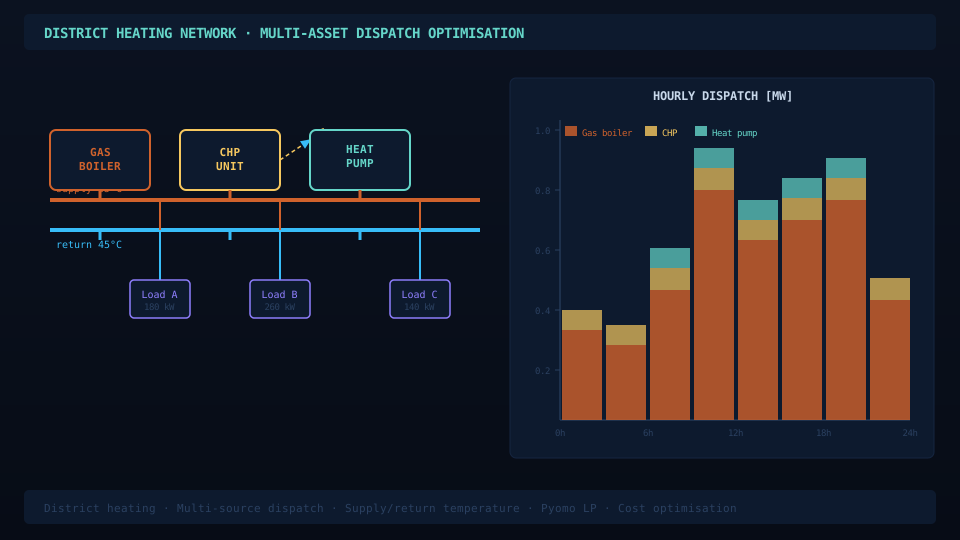
Woodchip and geothermal operate at their upper limits continuously, providing the stable renewable base. CHP fills the remaining demand gap, ranging between 572 and 651 MWh depending on period. Heat pumps contribute 0–50 MWh intermittently, deployed only when economically or operationally advantageous. No electricity purchases from the grid were required, confirming a high degree of self-reliance in the modelled configuration.
CHP electricity generation remained at 0 MWh during the analysed base-case periods, suggesting that cogeneration was not triggered under base-case cost conditions. This is a key finding: the optimiser prioritised heat output over electricity co-production, pointing to an opportunity in Step 4 where spot-price-linked CHP dispatch could unlock additional value.
Scenario trade-offs
The base-case dispatch established a clear priority order: renewable base load (woodchip, geothermal) first, flexible dispatchable CHP second, heat pumps as marginal support. This pattern held even as the objective function changed from cost to emissions in Step 5, because the lowest-cost technologies (woodchip, geothermal) are also zero-carbon.
The cost–emissions trade-off only becomes sharp when CHP — which carries 180 kg CO&sub2;/MWh — is competing with higher-cost but cleaner alternatives. Storage integration (Step 3) reduces dependence on CHP peaks by allowing surplus renewable heat to be shifted in time, which simultaneously reduces costs and emissions.
Limitations
- CHP cogeneration was not fully exploited in the base case; a spot-price electricity signal (Step 4) was needed to activate it.
- Geothermal and woodchip uniform outputs may underrepresent seasonal constraints in real systems.
- The model did not include a cooling demand or bidirectional heat exchange, limiting applicability to heating-only scenarios.