Delhi: the MSW crisis
Delhi generates 10,990 tonnes/day of municipal solid waste — all of it collected, but only 5,194 TPD treated. The remainder (5,533 TPD) is landfilled, with a significant fraction (~6,000 TPD) burned in open landfills. Three legacy landfills are severely overburdened: Bhalswa (operational since 1994), Ghazipur (1984) and Okhla (1996). Lack of source segregation means biodegradable and non-biodegradable waste arrive mixed, limiting the technological options for both energy recovery and recycling.
Delhi: proposed roadmap
The proposal argued for a phased, technology-matched approach aligned with Delhi’s segregation reality:
- Immediate (0–3 years): Mandatory source segregation policy with enforcement; decentralised biomethanation (anaerobic digestion) plants at ward level to handle organic waste and capture landfill methane from existing sites; community composting centres.
- Medium term (3–5 years): Refuse-derived fuel (RDF) production from the non-biodegradable fraction as segregation rates improve toward 60–70%. WTE combustion feasible only once feedstock quality is controlled — targeting 50% diversion from landfills and enough generation for approximately 8,000 households.
- Long term (>5 years): Gasification and pyrolysis for residual mixed and contaminated waste streams; legacy landfill remediation plans for Bhalswa, Ghazipur and Okhla. Waste-picker integration into the formal system to both preserve livelihoods and improve segregation quality.
The core argument: WTE is not a shortcut around segregation — it requires clean, consistent feedstock. Biomethanation is more tolerant of mixed organic waste and should come first, with combustion-based WTE following only as segregation infrastructure matures.
Kozhikode: WTE plant design
Kozhikode processes 600 tonnes/day of MSW. The existing windrow composting facility at Njelliyamparamba has insufficient capacity and pollution problems from non-biodegradable contamination. The city operates a 128 MW thermal (diesel) power plant.
The Group 8 proposal split the 600 TPD waste stream 50/50 between incineration and biological treatment:
Incineration pathway (300 TPD non-biodegradable)
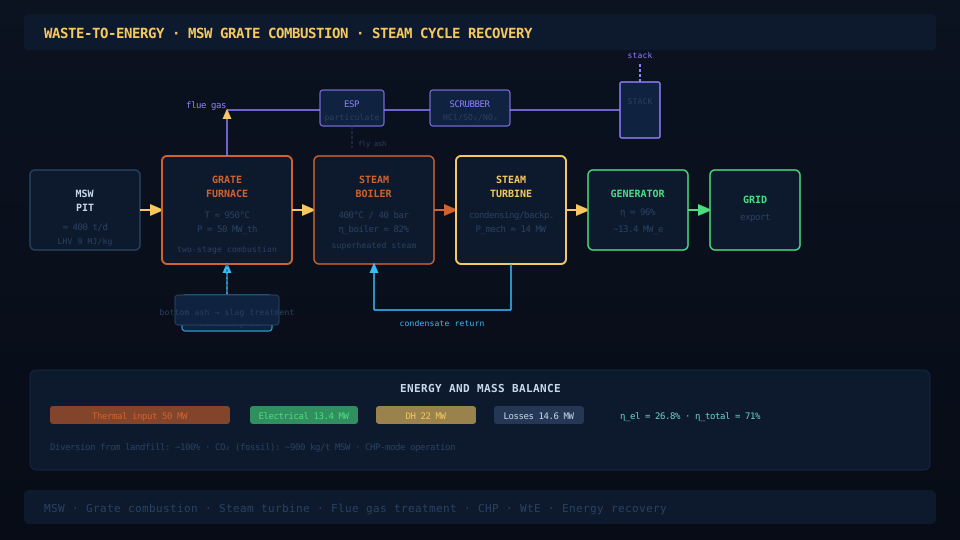
- Technology: MSW grate furnace (not CFB) with cold-condensing steam power plant
- Electrical efficiency: 20%
- Burnable waste LHV: 16 MJ/kg
- Plant electrical capacity: 11.11 MW — capable of substituting a significant portion of the 128 MW diesel plant output
- Flue gas cooled below 200°C before entering the pollution control system to ensure dioxin/furan destruction
Biological treatment pathway (300 TPD biodegradable)
- Feedstock dilution: 600 tonnes water added (1:2 ratio with 300 TPD organic waste)
- Biological waste LHV: 4 MJ/kg
- Retention time: 30 days
- Total solids: 20%; volatile solids: 80%
- Digester volume required: 36,000 m³
- Biogas production: 32,200.2 m³/day
- Application: fuel for 214 biogas buses per day — directly displacing diesel in Kozhikode’s public transport fleet
Combined benefits
- Reduced dependence on the 128 MW diesel power plant (coal/diesel electricity generation)
- Elimination of landfill need for the processed waste stream
- Displacement of diesel from public transport via biogas buses
- Pollution reduction from the current windrow composting site
Technology selection rationale
Grate furnace was chosen over circulating fluidised bed (CFB) because it handles heterogeneous MSW with lower pre-processing requirements. CFB requires more uniform fuel particle size, which would demand additional shredding and sorting infrastructure not yet in place. Cold condensing mode was selected over combined heat and power (CHP) to maximise electrical output in a city where district heating is not the primary priority.
The biological treatment route was selected alongside incineration rather than as an alternative because anaerobic digestion is specifically suited to the high-moisture organic fraction, which has too low an LHV (4 MJ/kg vs 16 MJ/kg for the combustible fraction) for efficient combustion.