← Back to experience

Alleima · Energy efficiency · Comparative audit methods

Energy Efficiency Intern - Alleima AB

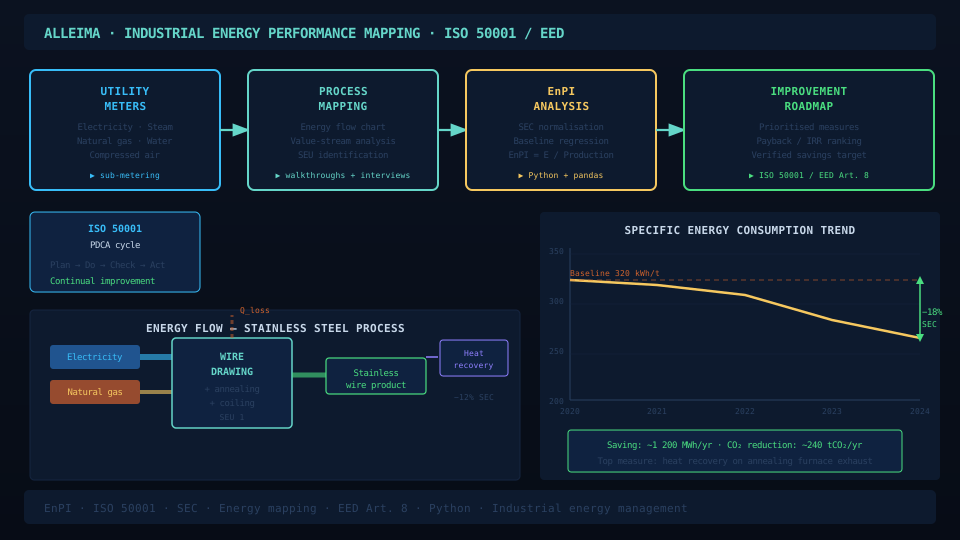
Industrial energy-performance mapping, KPI/EnPI development, metering-readiness assessment and comparative audit-method framing across global sites.

Industrial energy KPI mapping visual

What I contributed (public-domain summary)

  • Built a comparative regulatory analysis of industrial energy-audit obligations across multiple jurisdictions in Europe, North America and Asia — mapping each regime's mandatory triggers, certifying standards and enforcement bodies.
  • Designed a three-tier audit-methodology concept: certified ISO 50001 sites (deep integration with EnMS), active-EMS sites (hybrid internal-plus-third-party reviews) and lower-maturity sites (simplified audits with shared reporting).
  • Specified the core audit components shared across all tiers: annual energy balance, site walkthrough, EnPI baseline, measure identification, CAPEX/OPEX analysis, measurement & verification (M&V).
  • Drafted a phased rollout plan and a governance pattern (recurring cross-site forum, shared audit library, benchmarking dashboards) for translating standardised methodology into an operating routine.
  • Authored the M&V chapter: methodology for verifying claimed savings, generic limitations of savings quantification under partial-metering conditions, and recommendations for strengthening it.

Site names, internal system names, plant-level consumption figures and the consultancy report itself are intentionally omitted — that material belongs to Alleima.

Regulatory landscape (public-domain context)

Industrial energy-audit obligations differ widely across jurisdictions

The starting point for any multi-site harmonisation work is the public-law regulatory landscape. Common patterns I worked with:

  • Sweden / EU — energy-audit mandatory above a defined consumption threshold under the EU Energy Efficiency Directive (EED); ISO 50001 certification is one accepted compliance pathway.
  • Germany — energy-audit mandatory under the Energy Services Act (EDL-G) for non-SMEs; tax-relief programmes link explicitly to ISO 50001 certification.
  • Netherlands — energy-savings reporting through the RVO eLoket system; ISO 14001 is widely deployed; ISO 50001 is the natural upgrade path.
  • Czech Republic — EU-mandated audits enforced by the National Energy Authority.
  • United States — no federal mandate; state-level instruments (e.g. Washington's Climate Commitment Act 2021) create indirect pressure via GHG reporting thresholds.
  • India — sector-specific Perform-Achieve-Trade (PAT) scheme under the Bureau of Energy Efficiency, applicable only to Designated Consumers above defined thresholds.
  • China — national audit guidelines for large users, delegated to provincial energy authorities; coverage depends on local designation.

The observation that drives any harmonisation effort: regulations diverge, but every regime ultimately requires recurring audits, identification of Significant Energy Users, and economic assessment of measures.

Methodology concept

Tiered audit framework — the engineering idea

The methodology I developed is a generic tiered audit-framework concept: instead of pushing every plant to ISO 50001 (often unrealistic), tier each site by EMS maturity and apply a calibrated audit cycle. All tiers share the same core components and reporting template so cross-site comparisons stay valid.

  • Higher tier — certified EnMS sites: deep integration with the corporate energy-management system, continuous monitoring, equipment-level EnPIs.
  • Middle tier — active-EMS, non-certified sites: hybrid audits (internal review plus periodic third-party verification), sub-metering of major systems.
  • Lower tier — voluntary / low-maturity sites: simplified audits, low-cost KPIs (annual energy balance, specific energy per tonne), alignment with available external incentive programmes.

Core audit components shared across all tiers

  • Annual energy balance (electricity, fuels, compressed air, steam, cooling)
  • Site walkthrough (processes, support systems, maintenance practice)
  • Baseline + EnPIs at process and plant level
  • Measure identification with quantified savings, cost and payback
  • CAPEX/OPEX analysis (payback, ROI, lifecycle cost)
  • Measurement & Verification (M&V) for post-implementation tracking

Site-specific adaptations and named-plant detail belong to the proprietary deliverable and are not published.

Reflection

What I learned about cross-plant industrial energy work

  • Metering is the gate. No EnPI is more credible than the meter it rests on; meter upgrades typically need to come before claimed savings.
  • Harmonisation beats certification. A tiered framework with shared internal methodology scales better across a multi-site footprint than blanket ISO 50001 mandates.
  • Cross-plant comparisons are political. Plant-to-plant benchmarks require enough methodology consistency that the regional energy lead trusts the number — that's an audit-method specification, not just a KPI.
  • Governance is the multiplier. A recurring forum + a shared library of templates does more long-term work than any single audit cycle.
  • The decision comes before the data. The most useful filter I learned: "What decision will this indicator support?" If the answer is unclear, the indicator is not worth the effort.

Transferable value

Why this experience matters

The role developed methodology skills — boundary, baseline, drivers, residual diagnostics, metering readiness, M&V, governance — that anchor the EnPI Toolkit and the EU ETS Calculator elsewhere in the portfolio. It demonstrates how I turn industrial energy context into practical measurement, KPI and decision-support structures for both technical and management audiences. Internal site detail, plant consumption figures and the consultancy deliverable itself are not republished.