Industrial context and problem
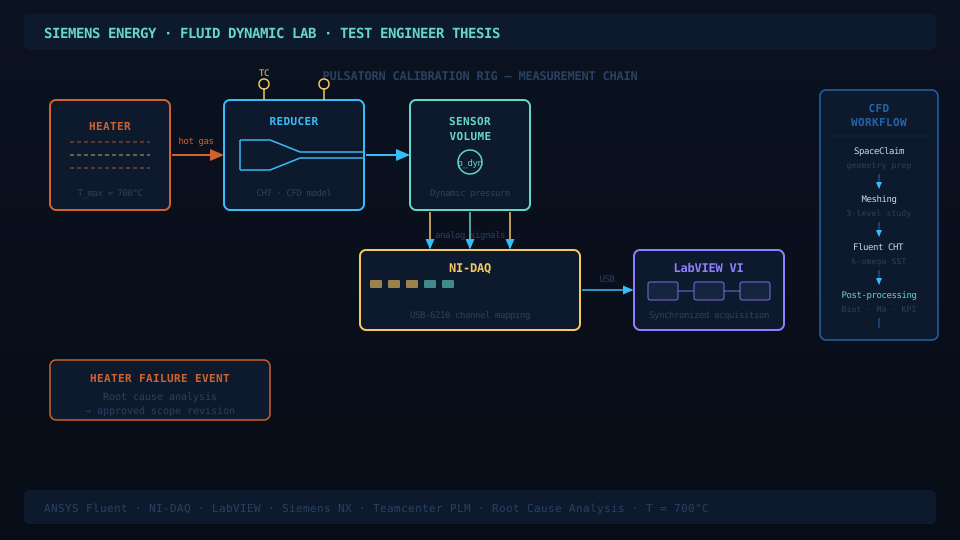
I worked in Siemens Energy Finspång's Fluid Dynamic Lab on the Pulsatorn platform, a high-temperature calibration rig used for dynamic pressure sensors in gas-turbine-relevant conditions. The assignment focused on a reducer section between heater and downstream rig volume where both pressure-loss behaviour and thermal delivery were critical to test quality.
Approach and execution
I owned the day-to-day simulation workflow from geometry preparation in ANSYS SpaceClaim to meshing strategy, solver setup and KPI-driven post-processing in ANSYS Fluent. The thesis campaign used steady-state compressible CFD and conjugate heat transfer with k-omega SST, inlet conditions of T = 673 K and P_gauge = 100,000 Pa, and multiple outlet-pressure cases for adiabatic and CHT comparison.
Before full comparison runs, I completed a three-level mesh independence process and verified that monitored engineering outputs remained within a 2% band. I then used Biot number analysis (Bi = 0.003-0.004) and flow-regime checks to interpret geometry behaviour, including near-choked versus supersonic tendencies at key locations.
Validation link and test support
In parallel, I commissioned NI-DAQ channel mappings and updated LabVIEW VI logic for synchronized acquisition of thermocouple and pressure signals. During high-temperature preparation, a heater failure interrupted sustained testing; I documented the event, supported root-cause analysis, and aligned the technical scope with an approved supervisor revision so the work could still produce defensible outcomes.
Outcome and relevance
The role built practical simulation-to-test discipline: CFD/CHT modelling, uncertainty-aware interpretation, instrumentation readiness, structured troubleshooting, and clear documentation of assumptions and limitations. It is the strongest evidence in my portfolio for early-career CFD, thermal-fluid and test/validation engineering roles in high-temperature test and instrumentation environments.