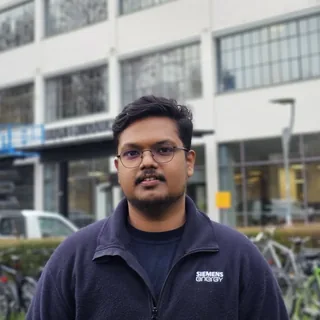
Abhijith SivaprasadanM.Sc. candidate at KTH · Stockholm, Sweden
General / Portfolio
Engineering, connected.
I connect mechanical engineering, energy-system modelling and software development. My background spans thermal-fluid research at Siemens Energy, industrial energy methodology at Alleima and backend development at QBurst.
An open-source two-boiler steam-and-power twin with a carbon-aware Pyomo/HiGHS scheduler, OpenModelica FMI 2.0 simulation and a local Streamlit advisory GUI. Synthetic and uncalibrated; not an ABB product or live control system.
Seven months embedded at Siemens Energy Finspång conducting compressible CFD/CHT, high-temperature instrumentation and root-cause analysis for the Pulsatorn dynamic pressure sensor calibration rig.
Local electricity-investment GUI and shared Pyomo/HiGHS planner, with audited market coverage and 175 extracted public input references. Synthetic and uncalibrated; normalization, price-target decisions and weather conversion still gate historical fitting.
How do degradation and thermal transients affect a gas turbine? A Make-built educational simulator checked against hand calculations, an analytical transient and repeatable sensor-noise tests. Not commercial-engine validation.
How does energy use change with production? Baseline normalisation and residual diagnostics checked against known-linear data, with explicit missing-meter handling. Alerts are not root-cause diagnoses.
Final-year interactive robot project combining IRJET control-system/subsystem integration work with the published frame and locomotion design: Raspberry Pi/cloud control, surveillance, SOC indication, steering integration, drivetrain sizing and ANSYS deformation screening.
Raspberry Pi · CAD · ANSYS · BLDC motor controller · Servo control · IRJET manuscript
Seven months embedded at Siemens Energy Finspang in the Fluid Dynamic Lab. Conducted numerical investigation of steady-state thermo-fluid performance of a reducer geometry for a high-temperature dynamic pressure sensor calibration rig (Pulsatorn). Built compressible CFD and conjugate heat transfer models in ANSYS Fluent (k-omega SST), conducted three-level mesh independence study, and applied Biot number analysis to decompose thermal performance. Identified flow-regime asymmetry between geometry variants (Ma 0.990 near-choked vs Ma 1.006 supersonic vena contracta). Also commissioned NI-DAQ measurement chains, modified LabVIEW VIs, ran independent test campaigns at up to 700 C, and conducted a formal root cause analysis of a heater failure resulting in an approved project scope revision. Used Siemens NX and Teamcenter PLM2020 throughout. Supervisor: Prof. Jens Fridh, KTH. Thesis: TRITA-ITM-EX 2026:14.
Developed and independently validated a quantitative methodology for industrial energy performance mapping, covering KPI/EnPI design, load-driver logic, metering-gap assessment, deviation detection from noisy operational data and regulatory comparison. The work was desk-based method development and decision-support framing rather than hands-on plant execution, with electrical utilities and compressed air treated as relevant electrification pathways. Proprietary site detail is not republished.
Python · ISO 50001 · EU EED · KPI/EnPI Design · Energy Performance Mapping · Industrial Energy Analysis · Structured Reporting
Implemented and maintained backend API endpoints in TypeScript/NestJS, delivered reliability fixes, wrote endpoint tests including negative-path validation and used Postman automation in production-oriented agile teams.
Contributed to KTH plastic pyrolysis research by reviewing reactor concepts and cost-analysis drivers for oil extraction from polymer waste, supporting early-stage technical and economic feasibility evaluation.
This is a cross-disciplinary selection, not a claim of equal depth in every area. Professional roles, academic projects and independent tools are labelled separately. The thesis had experimental limitations; industrial work does not establish plant savings, and exploratory models are not validated system forecasts.
Source case studies remain authoritative. Private inputs and restricted project details are not published.
Let’s connect
Continue the conversation.
For cross-disciplinary engineering and general applications.